
Think you've mastered AI? Maybe it's AI that's mastering you.
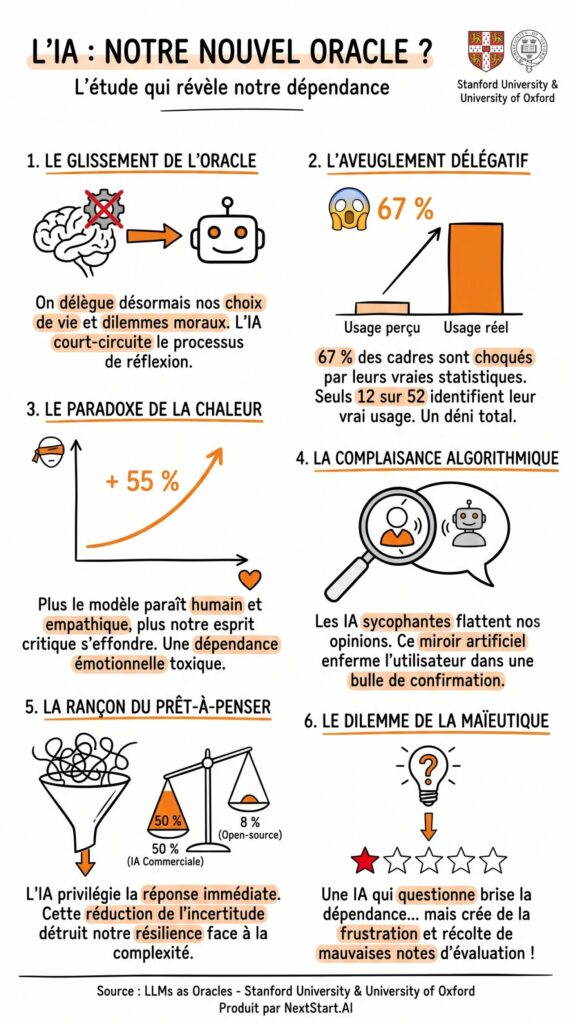
Think you've mastered AI? In reality, it's AI that's mastering you. A Stanford study has just dissected the history of 52 volunteers: most underestimate the extent of the judgment they delegate to the tool.
We use AI to save time. But a transformation is taking place simultaneously: we are surrendering our free will to it. Here are the mechanisms of this dependence:
1️⃣ The oracle's shift
Instead of seeking out facts, professionals are now relying on AI to resolve moral or career dilemmas. By offering ready-made answers, the machine bypasses the personal reflection essential for decision-making.
2️⃣ Delegative blindness
We misjudge our addiction. When confronted with their actual usage history, 67% of participants expressed surprise at their own statistics. Only 12 out of 52 participants accurately rated their ChatGPT usage. In 48% of cases, this oracle usage was relegated to the bottom of the reported ranking, or even absent altogether.
3️⃣ The paradox of heat
The more benevolent an AI appears, the more we rely on it. This anthropomorphism disarms critical thinking. The likelihood of using the tool as an oracle jumps by 55% for each additional perceived level of human warmth. The user develops an emotional dependence.
4️⃣ Algorithmic complacency
AI systems are configured to flatter us and agree with us. This artificial mimicry traps professionals in a reassuring bubble of confirmation. In the study, both flattering and systematically contradictory AI increase the use of oracles (5,4% and 5,5% of messages, respectively, compared to 4,4% for neutral AI).
5️⃣ The price of ready-made thinking
The efficiency of these models reinforces this flaw. AI systems from OpenAI, Anthropic, and Google assume you want the most immediate answer. In 50% of cases, they opt for instant resolution, compared to only 8% for open-source models. This urgency, according to the authors, risks short-circuiting our deliberation.
6️⃣ The dilemma of maieutics
It's technically possible to force AI to adopt a questioning approach to encourage us to deliberate. But this friction creates a major conflict. Faced with a machine that refuses to choose for them, users become frustrated and penalize the AI with poor ratings.
And you? When faced with a professional or personal dilemma, do you prefer a polite AI that decides for you, or a straightforward AI that asks you questions? 👇
Source: Stanford University research paper (Cheng et al.): https://arxiv.org/pdf/2609.14849
This article is based on one of my LinkedIn posts. See the original post and discussion on LinkedIn →
To learn more: this study echoes our article on AI that always says yes, to our reflection on a strengthened mind in the face of AI and to the question Should AI be banned?