
A strengthened mind against AI
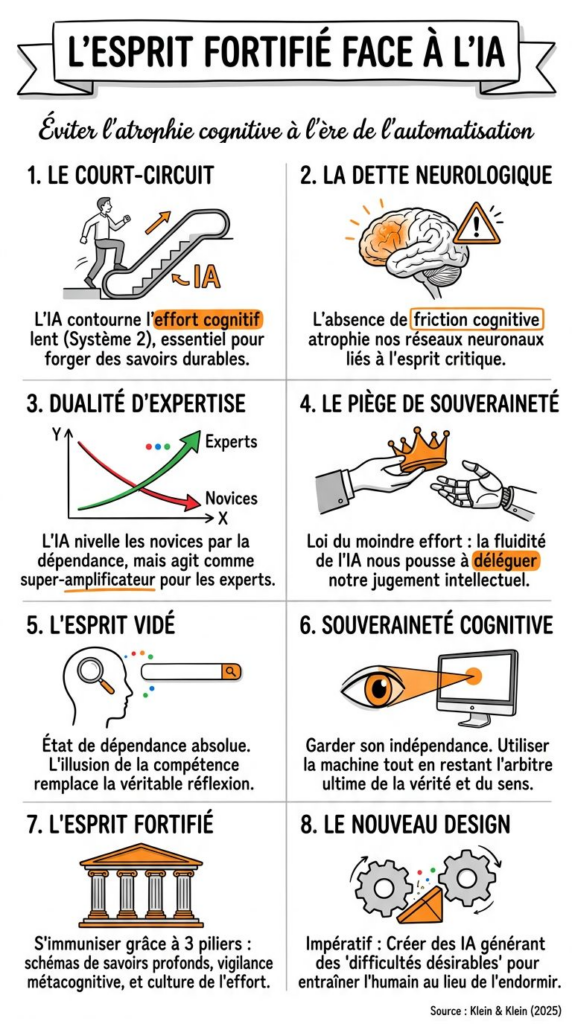
We often hear that AI frees us from tedious tasks, allowing us to engage in more strategic thinking. However, by systematically delegating problem-solving to machines, we reduce the cognitive processes essential for learning.
⚡️Cognitive short-circuiting: Learning and mastering a subject requires friction. By giving us the answer instantly, AI can short-circuit our deliberate thinking (the famous System 2), which is essential for building lasting knowledge and exercising our critical thinking.
📉 A possible cognitive debt: In neurology, the saying is "use it or lose it." By constantly avoiding the effort of verification, we could undertrain the mechanisms involved in control, error detection, and critical thinking.
⚖️ The cruel "duality of expertise": As soon as a task becomes ambiguous, complex, or pushes the tool's limits, a novice can be at a disadvantage due to a lack of sufficient knowledge to identify errors. An expert, on the other hand, can leverage their expertise to assess and correct the situation.
👑 The Sovereignty Trap: Faced with eloquent machines, the trap is twofold: cognitive (law of least effort) AND motivational. AI creates an illusion of competence and immediate gratification. The risk? Blindly delegating our judgment and responsibility to the tool.
🫥 The empty mind: The long-term risk is not that humans lose their ability to reason, but that they confuse "instant access to the answer" with "competence".
👁️ The goal: Cognitive sovereignty: The solution is not to turn off our favorite AI. It's about using them while remaining the ultimate arbiter of quality, meaning, and truth.
🏛️ Cultivating a "fortified mind": Tomorrow's user will need to protect their three key strengths against machines: a deep foundation of knowledge (to detect biases and blind spots in AI), sharp metacognition (knowing when and how to verify), and a habit of critical thinking. This involves resisting instant answers, accepting the discomfort of "I don't know yet," and deliberately choosing friction over shortcuts.
⚙️ Towards a new design of tools: AI designers must evolve their tools, moving from simple "answer dispensers" to partners generating "desirable contradictions" that challenge us and force us to reason.
And you? How do you maintain your learning abilities when faced with tools that claim to have all the answers? 👇
Source: Research paper “The extended hollowed mind” https://www.researchgate.net/publication/398569016_The_extended_hollowed_mind_why_foundational_knowledge_is_indispensable_in_the_age_of_AI
On the same topic: Paper "Scaffolding critical thinking with Gen AI" https://www.sciencedirect.com/science/article/pii/S2666920X26000342
This article is based on one of my LinkedIn posts. See the original post and discussion on LinkedIn →
To learn more: discover how AI is locking in youth employment, Why AI always says yes and if AI will either destroy or transform our jobs.