Consulting · Cross-departmental AI Audit
Choose your use cases
Each department has identified its own use cases, the IT department has its own priorities, and no one has the overall view to make a decision. In three weeks, we conduct an AI audit with each department, uncover its use cases, and quantify them. The executive committee leaves with a portfolio of prioritized use cases, those that serve multiple departments simultaneously, common dependencies (data, tools, governance), and a twelve-month roadmap. This approach is designed for general management and transformation leadership teams who want to make a comprehensive organizational decision, rather than a department-by-department approach.
Starting from €6,500 excluding VAT for five directions · Written proposal within 24 working hours, without obligation.
What the diagnosis determines
When AI arrives via departmental channels, each progresses at its own pace: marketing tests one tool, finance tests another, HR awaits a position from IT, and legal expresses concern. The same use cases are examined three times, shared use cases are not championed by anyone, and the executive committee arbitrates on matters that are not comparable. A cross-functional assessment puts everyone on the same page before budgets are committed.
- Listen to each direction on its own ground: its processes, its volumes, its irritants, its existing uses, its fears.
- Identify the use cases for each direction and identify those that recur from one direction to another: these are the first to launch.
- Qualify all use cases on a single grid (value, feasibility, risk) and estimate their cost and expected return, in comparable orders of magnitude between directions.
- Making common dependencies visible: data to prepare, tools to choose, rules to set, skills to develop, which condition several use cases at once.
- Give the management committee the information it needs to make decisions: a ranked portfolio, a twelve-month roadmap, and the decisions to be made within the month.
Our three-step method
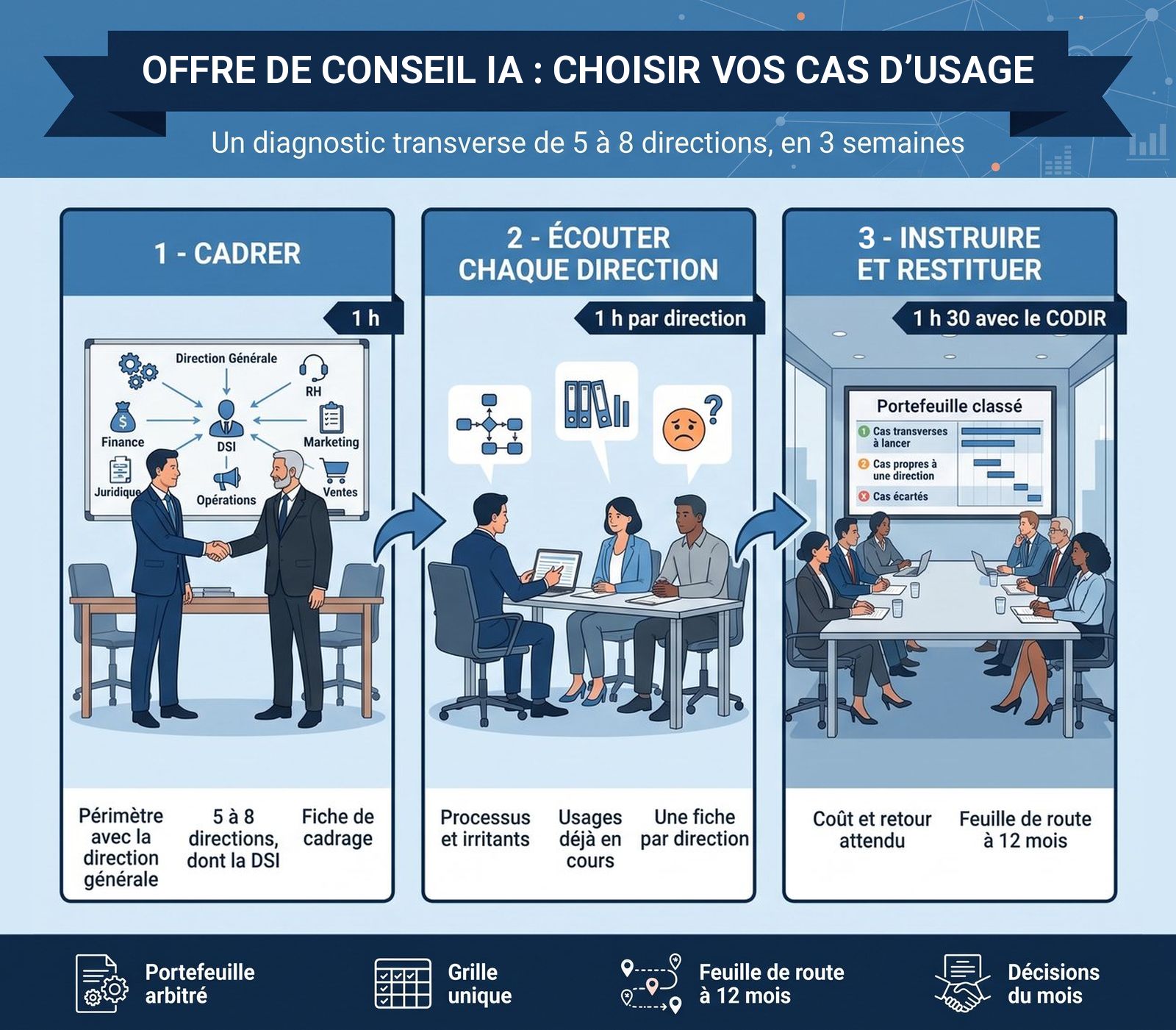
Three weeks, a senior consultant meeting with each management team individually, and a prioritization grid proven in over 30 organizations.
Frame
Define the perimeter with the general direction. One hour.
- Interview with the sponsor: organizational challenges, directions to be covered, decisions expected from the management committee, scheduling constraints.
- Choice of departments encountered: five in the core, more in extended scope, business lines and support functions, with the IT department systematically.
- Interview preparation: interlocutors, common questionnaire, documents to gather (organizational charts, tools in place, AI projects already launched).
- Deliverable: the framework document, validated before the first interview.
listen
Meet with each department on their own turf. One hour per department.
- Interview with the director and one or two people who do the work: key processes, volumes, time spent, irritants, data handled.
- Inventory of existing uses, official or unofficial, and the tools that support them.
- Initial use cases formulated with management, based on their real-world examples.
- Deliverable: a sheet per department, reviewed by them, with their use cases and constraints.
To educate and to give back
Qualify, quantify, classify, decide. Instructions following interviews, then an hour and a half with the management committee.
- Consolidation of records by department: duplicates and use cases common to several departments appear.
- Qualification of each use case on the single grid: value, feasibility, risk (data, AI Act, dependence on a supplier).
- Identifying common dependencies: the data, tools, and rules that multiple use cases need at the same time.
- Cost estimation and expected return for each selected use case, with assumptions clearly stated and comparable between departments.
- Portfolio ranking: cross-functional use cases to launch first, use cases specific to a department, those to discard.
- Twelve-month roadmap: sequencing, common prerequisites, responsible parties, first pilots.
- Deliverable: the diagnostic report, submitted to the management committee, with the decisions to be made within the month.
The format: three weeks, all directions
One hour for initial planning, one hour for each department, and one and a half hours for feedback, spread over three weeks to allow sufficient time for analysis. This initial framework covers five departments. Beyond that, each additional department, whether within the organization or a subsidiary, adds a one-hour interview.
Interviews
One hour per department, with the director and those who do the work, to bring out its use cases.
Instruction
To classify use cases on a single grid, quantify them and identify common dependencies.
Executive Committee Report
Present the ranked portfolio, expected costs and returns, the roadmap, and finalize the decisions.
Why use NextStart for diagnostics?
A diagnosis is valuable because of the accuracy of its estimates and its ability to get each department to talk about its actual work. The consultants who conduct ours then build the agents and coworking spaces with the teams: we know what a use case really costs to put into production, and what causes it to fail when it passes through multiple departments.
- Estimates based on what we have seen work, or fail, in more than 30 organizations.
- A single grid for all departments: use cases are compared, the management committee arbitrates on common bases.
- Interviews conducted by consultants trained in facilitation, which give equal weight to the IT department and the business units, without one imposing its agenda on the other.
- Independence from publishers: the choice of tools does not depend on any license.
- A published framework: 6 areas of analysis, 54 key success factors, 16 pitfalls. Discover the study →
Two ways to start
The foundation for an organization and five departments, or the extended diagnosis when several additional entities, subsidiaries or departments need to be covered.
Five-direction diagnosis
One hour of framing, five one-hour interviews, one and a half hours of feedback to the management committee, and the processing of the file between sessions: sheets by department, portfolio of qualified and quantified use cases, common dependencies, twelve-month roadmap, diagnostic report.
€6,500 to €8,500 excluding VAT
Three weeks, five directions
Multi-entity diagnosis
The core framework is supplemented by one-hour interviews for each additional department, within each entity or subsidiary to be covered. A single diagnostic report is produced, with use cases categorized at the group level.
From €9,500 excluding VAT
Four to six weeks depending on the number of departments and entities
What you get
- One sheet per department: key processes, current uses, formulated use cases, data constraints, reviewed by the department concerned.
- The organization's portfolio of use cases, qualified on a single grid (value, feasibility, risk), with cross-functional use cases distinguished from use cases specific to a department.
- The estimation of the cost and expected return of each selected use case, with explicit and comparable assumptions between departments.
- The map of common dependencies: data, tools, rules of use, skills, with what needs to be addressed before launching.
- An exploratory mock-up of a cross-functional use case, presented as a feedback: a proof of intent, not a production deliverable.
- The diagnostic report, submitted to the management committee, with the twelve-month roadmap and the decisions to be made within the month.
Solid consulting experience
Since 2016, we have been supporting organizations in their transformation, and since 2023 in their generative AI projects. We have supported over 30 organizations, trained 4,850 professionals, and achieved an average satisfaction rating of 9,4/10. See our references →
Our reference framework: an independent study conducted over 10 years with 54 organizations, structured into 6 areas of analysis, 54 key success factors and 16 pitfalls to avoid. Discover the study on NextStart.FR →
FAQ
Is the diagnosis an AI audit of the company?
Yes, an AI audit that starts from the ground up, from each department's perspective, rather than a generic questionnaire. It assesses current practices, both official and unofficial, evaluates each use case using a standardized framework (value, feasibility, risk), and leads to quantified decisions for the executive committee. The difference with a traditional audit: it doesn't stop at simply stating the facts; it delivers a prioritized portfolio and a twelve-month roadmap.
How does this differ from the AI Maturity Grid?
La AI Maturity GridThis free service assesses the organization across six dimensions in a 90-minute workshop. The cross-functional diagnostic starts with the departments and their use cases: it identifies them, quantifies them, and categorizes them for the management committee to decide upon. If you want to know where you stand, the framework is the right starting point; if you want to know what to implement, and in what order, the diagnostic is the answer.
Do we need to have use cases in mind already?
No. You need management teams willing to talk about their processes and pain points for an hour. The interviews bring use cases to light; those you've already identified serve as a starting point.
How many directions need to be covered?
Five in the core team (€6,500 to €8,500 excluding VAT), a mix of business and support functions, with the IT department included in all cases. Below five, the assessment loses its cross-functional relevance: a program framework That's enough. Beyond five, or with several entities, the extended scope applies (from €9,500 excluding VAT).
Who do we need to mobilize?
The sponsor, usually the general management or the transformation department, is present for the initial scoping phase. For each interview, the director and one or two people conduct the work. The management committee presents the feedback.
What is the value of the estimated expected return?
This is a defensible order of magnitude, not a promise: time saved, lead times reduced, quality improved, risks avoided, calculated based on your volumes and what we have measured in comparable cases. The assumptions are clearly stated in the report, using the same methodology for all departments, so that the management committee can compare and discuss them. To then measure the actual gain of each use case launched, the AI Measurement and ROI Kit details the before/after protocol.
What happens after the diagnosis?
The steering committee defines the use cases to be launched. Each team then builds upon this with its own team. Agent Studio, Cowork Studio or Code StudioThe shared dependencies (charter, governance, choice of tools, training) fall under the purview of Framing your programYou remain free to continue with us or with your own teams.
How long does the diagnosis take?
The core phase takes three weeks: framing and interviews in the first week, instruction in the second, and feedback in the third. The extended scope takes four to six weeks depending on the number of departments and entities involved.
How much does it cost ?
The basic package covering five departments is offered at a price between €6,500 and €8,500 excluding VAT, depending on the preparation required. The expanded package starts at €9,500 excluding VAT, depending on the number of departments and entities. A detailed proposal will be sent to you within 24 business hours following an initial discussion.
Start your diagnostic
Describe your situation in a few lines: the departments involved, what's already underway on the AI side, what the management committee expects, and your deadlines. A senior consultant will get back to you within 24 business hours with a proposal and a date for a scoping meeting. You can also book a 30-minute consultation directly.
Do you prefer to call or write? +33 1 89 16 48 05 or hello@nextstart.aiYour contact details are only used to reply to you.
NextStart is a training organization registered under number 11756140675. This registration does not constitute state approval.