Council · Framework for Uses
Write a charter of uses
Your employees are already using AI, with or without rules. A downloaded, signed, and filed away charter is useless if it doesn't specify which tools, which data, how it's used, and who answers questions. In four weeks, we co-create a charter with your business units, your IT department, your DPO, and your employee representatives—a charter that teams will actually follow because they wrote it: data classification, a tool register, rules for users, a review process, and compliance with the GDPR and the AI Act.
From €3,000 excluding VAT for a one-day charter · Written proposal within 24 working hours, without obligation.
Why do the charts end up in a drawer?
Most of the AI charters we read were written by the legal department or the IT department alone, in a week, using a template. They state what is prohibited, rarely what is permitted, and never specify which tools or data are allowed. As a result, teams don't read them, practices continue as before, and when an incident occurs, the charter protects the organization on paper but has prevented nothing. A useful charter is short, concrete, written with those who will implement it, and supported by someone available to answer questions.
- Clearly state what can be done, with what tools and what data, rather than a list of prohibitions.
- Covering today's uses: agents created by business processes, browser extensions, transcribed meetings, AI embedded in software.
- Comply with the GDPR, the AI Act and the obligations to inform and consult with employee representatives.
- Plan who will keep the charter alive, how to ask a question and when to revise it.
Our four-step method
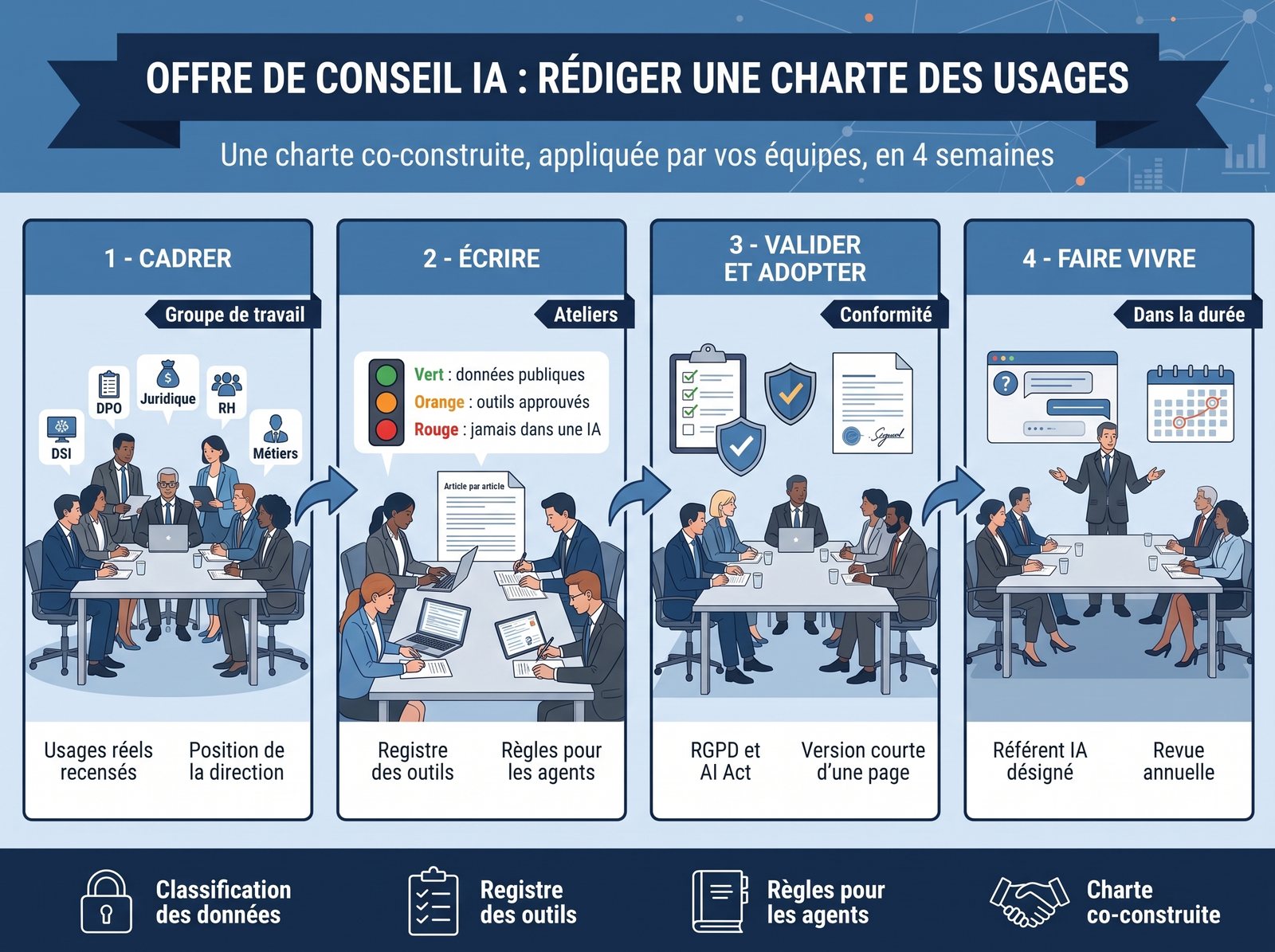
Four weeks, four to six days of intervention, a multidisciplinary working group and our charter model as a starting point, so as not to start from a blank page.
Frame
Bringing together the right people and starting from real-world uses.
- Working group: CIO, DPO, legal, HR, two or three business lines, employee representatives, a member of management.
- State of usage through short questionnaire and reading of administration consoles: what is used, tolerated, hidden.
- Company position agreed upon with management: what the charter should allow and what it should prevent.
- Deliverable: the scoping note and the map of existing uses.
To write
Write in a workshop setting, article by article, based on our template.
- Principles: transparency, human validation, responsibility, quality of productions.
- Classification of data into three levels and register of approved, tolerated, prohibited tools.
- Rules for agents, extensions, transcribed meetings and AI embedded in your software.
- Deliverable: the drafted charter, fifteen articles maximum, with its annexes.
Validate and adopt
Make the charter a document that is read, understood and signed.
- Legal review and compliance with GDPR and AI Act, with the obligation to control AI under Article 4.
- Information and, where appropriate, consultation with staff representatives, prepared with HR.
- Short one-page version, FAQ, integration into onboarding and internal regulations if necessary.
- Deliverables: the validated charter, its short version and the launch kit.
To live
Install something that avoids the drawer.
- Designated AI expert, question channel and response time.
- One-hour launch session for managers, with concrete cases that are being debated.
- Scheduled annual review and procedure for updating the tool registry.
- Articulation with the governance of your AI and agents when the park justifies it.
Why a NextStart Charter?
We make our charter template available free of charge, and many organizations use it independently. The mission adds what a template cannot: your actual practices, your decisions, the agreement of your employee representatives, and the team training that makes the charter applicable.
- A model already up-to-date with the AI Act and omnibus regulation (EU) 2026/1744, written from the guides of the DINUM, the CNIL and the ANSSI.
- The charter and user training in the same hand: these are the two most direct measures to respond to Article 4 of the AI Act.
- A practice of co-construction with staff representatives, in public and private organizations.
- Independence from publishers: the tool registry is based on your criteria, not on a catalogue.
Two ways to start
A one-day workshop to adapt our model to your organization, or the complete mission to co-create the charter with your stakeholders and implement it over the long term.
Charter in one day
A one-day workshop with a group of six to ten people (CIOs, DPOs, HR, business stakeholders) to adapt each article of our template to your tools, data, and uses. A finalized charter and a short version will be delivered within five business days.
€3,000 to €4,000 excluding VAT
One day, preparation and deliverable included, legal review at your expense.
Write a charter of uses
The four stages of the method over four weeks: framing and mapping of uses, drafting in workshops, legal review and presentation to staff representatives, short version, launch session for managers and revision mechanism.
From €8,000 excluding VAT
Four to six days of intervention depending on the size of the organization
What you get
- The AI usage charter, fifteen articles at most, with data classification, tool register and rules for agents.
- The one-page short version, the FAQ, and the launch kit for managers.
- Documented compliance: GDPR, AI Act, information or consultation of employee representatives.
- The charter's lifecycle system: AI referent, questions channel, annual review.
The 2026 AI charter template, ready to adapt
Before entrusting us with the project, or to get started on your own: our AI usage charter template in Word format, drafted based on the DINUM guide, the recommendations of the CNIL and ANSSI, and the charters published by government agencies and the Paris Bar Association. It is up-to-date with the AI Act and the omnibus regulation (EU) 2026/1744, in force since July 27, 2026.
- 15 articles with an editorial note for each choice to be made
- Classification of data (green/orange/red) and register of approved, tolerated, and prohibited tools
- Rules for AI agents, extensions, and transcribed meetings
- Regulatory calendar 2026-2030, CSE obligations, deployment checklist
Receive the template
The download link will be sent to you by email.
Solid consulting experience
Since 2016, we have been supporting organizations in their transformation, and since 2023 in their generative AI projects. We have supported over 30 organizations, trained 4,850 professionals, and achieved an average satisfaction rating of 9,4/10. See our references →
Regarding this type of co-construction approach: DGAC modernization program, with upstream survey, separate workshops for 38 field agents and 23 supervisors, then convergence session bringing together 33 participants to arrive at shared rules. See this mission on NextStart.FR →
FAQ
Why not just use the free template?
Many do it, and that's the point. The mission is useful when the charter needs to be negotiated between several departments, reviewed by employee representatives, cover a large range of tools and staff, or when no one has the time to write it. Most importantly, it adds team training, without which the charter remains just a document.
Should the Works Council be consulted?
A charter that introduces a new tool or a new rule for monitoring activity falls under the category of information and consultation; a simple best practices document falls under the category of information. We prepare the documentation with your HR department in both cases, and we recommend involving employee representatives in the working group from the outset.
What does the AI Act require of a charter?
Nothing directly. Since February 2, 2025, Article 4 of the AI Act requires companies that provide or use AI systems to take steps to develop their employees' AI skills, taking into account their role and the context of use. Omnibus Regulation (EU) 2026/1744, in force since July 27, 2026, has made this an obligation of means: it no longer requires guaranteeing a "sufficient level" for each individual, and the Commission and Member States must support these efforts, particularly those of SMEs. Enforcement has been the responsibility of national authorities since August 2, 2026. The charter is the right place to specify which uses require which training, and to document what the organization has done.
Does the charter cover agents created by the professions?
Yes, this has become the main topic: a Copilot agent or a ChatGPT agent engages the organization in a way that differs from a simple prompt. The charter defines who can create them, on what data, and with what declaration. When the number of agents exceeds a few dozen, the mission Governing your agents takes over with a register and a validation circuit.
How long does the mission take?
The entire project takes four weeks, including one week for legal review and presentation to employee representatives. The charter, drafted in a single day, is delivered within five business days of the workshop.
How much does it cost ?
The one-day charter is offered at a price between €3,000 and €4,000 excluding VAT. The full four-week mission starts at €8,000 excluding VAT, depending on the size of the organization. A detailed proposal will be sent to you within 24 business hours following an initial discussion.
Build your mission to suit your needs
Describe your context in a few lines: size of the organization, AI tools in place, existence of a charter or policy, deadlines. A senior consultant will get back to you within 24 business hours with a proposal tailored to your needs and timeline. You can also book a 30-minute consultation directly.
Do you prefer to call or write? +33 1 89 16 48 05 or hello@nextstart.aiYour contact details are only used to reply to you.
NextStart is a training organization registered under number 11756140675. This registration does not constitute state approval.