
Should AI be banned?
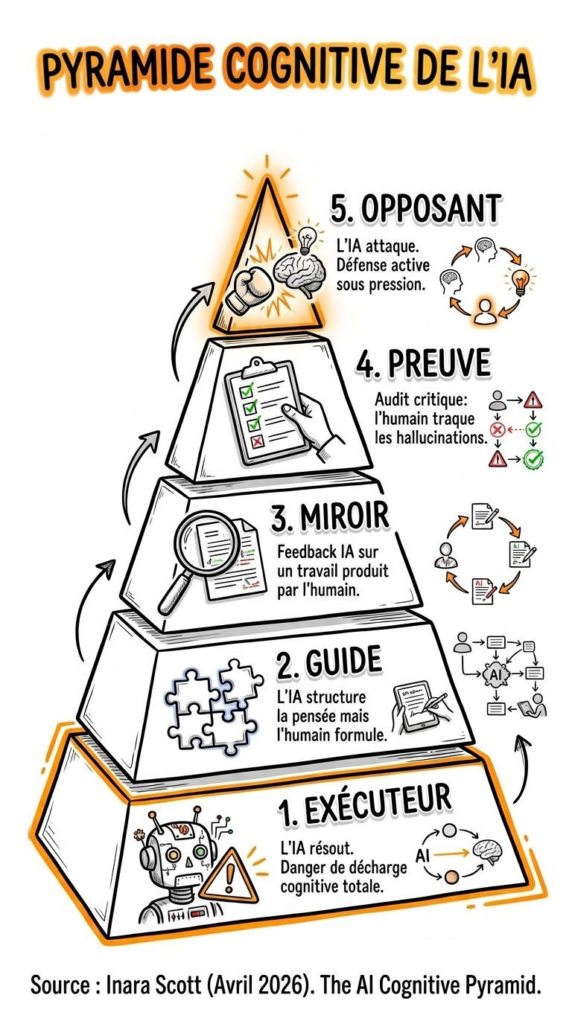
Should we ban AI? Wrong question. What we need to change is how we use it.
AI makes us faster, but if we are not careful, we risk transferring to the machine the mental work that makes us competent.
This phenomenon has a name: "cognitive offloading." Our brains are naturally energy-efficient. When faced with a chatbot that provides fluent and comprehensive answers, we tend to mistake access to the solution for possessing the necessary skills.
We therefore need to change our attitude towards the tool and move up the pyramid:
Level 1: THE EXECUTIONER 🚨
The default usage. AI writes the report or structures the strategy. The human simply reviews and approves it.
Conclusion: Peak immediate productivity, but erosion of long-term learning. The executor is not always problematic; it becomes so when the delegated task is the one that develops the targeted skill.
Level 2: THE GUIDE ⚠️
We're starting to regain control. Here, we configure the AI not to provide the solution, but to offer a methodology.
Example: "Ask me a series of questions to help me build my sales pitch step by step." The AI lays the foundation (the scaffolding), but it is the employee who must formulate the ideas.
Level 3: THE MIRROR💡
The initial effort is 100% human. You write a complex memo or design a strategy. You then submit this work to the AI, asking it to act as a critic: "Identify the blind spots in my proposal."
Conclusion: Human judgment remains paramount. AI serves as a metacognitive coach to refine already structured thinking.
Level 4: THE LISTENER 🔎
The roles are reversed: AI is tasked with producing analysis or claims… and it becomes an object of doubt. The human is transformed into an implacable listener.
The challenge: The exercise involves tracking down AI hallucinations, challenging its biases, sourcing and cross-referencing with internal literature. This requires a high level of prior expertise.
Level 5: THE OPPONENT🔥
The zone of maximum value, where tomorrow's experts are forged. AI is formally trained to play an antagonistic role (Socratic dialogue).
Example: "I have to present a difficult restructuring plan. Play devil's advocate and try to dismantle my argument." This is what's called a "desirable difficulty." Knowledge hoarding skyrockets.
AI is fundamentally compliant: when faced with your hesitation, it will always have the "executor's reflex" and try to do the work for you. Preventing this tendency isn't something that can be decreed; it requires organization. It's time to take back control of the tool.
And you, at which level of the pyramid do you operate most often? 👇
👇 Source: Research paper "The AI Cognitive Pyramid" by Inara Scott, April 2026 https://papers.ssrn.com/sol3/papers.cfm?abstract_id=6353318
This article is based on one of my LinkedIn posts. See the original post and discussion on LinkedIn →
To learn more: discover how to keep a strengthened mind in the face of AI, Why AI always says yes and if AI threatens our critical thinking.