
Customized professional training
AI training for innovation teams
Explore new opportunities faster and transform ideas into actionable concepts, scenarios, and roadmaps.
Starting from €1,500 excluding VAT per half-day · Written proposal within 24 working hours, without obligation.
The training in brief
Everything you need to make a decision, in nine lines. The objectives, process, and use cases are below.
- What it is
- A customized training in generative AI For innovation teams: a maximum of twelve participants, each working on their own computer, focusing on their own topics. No lectures or demonstrations: 70% hands-on practice.
- What we work on there
- Your explorations and concepts : transformation of verbatim comments into insights, documented state of the art, monitoring of calls for projects and funding, transition from ideas to scenarios and roadmaps.
- For who
- The teams innovation, R&D and transformationAll levels, including employees who have never opened the tool.
- Duration and rhythm
- 1 hour 30 minutes or half a dayAvailable in one go or in waves of sessions to cover the entire team. Also available as a webinar.
- Where and in what language
- At your premises anywhere in France, or remotely. French or English.
- Price
- €1,500 to €2,000 excluding VAT Half-day sessions for up to twelve participants, with a sliding scale of prices when sessions are repeated. See our price benchmarks.
- On which tool
- Yours: Copilot, ChatGPT, Claude, Gemini, Mistral or your secure internal assistant. We train within your tenant, without third-party tools.
- Funding
- Eligible for OPCO and ESF+ funding. NextStart is a registered training organization (No. 11756140675): the session is part of your skills development plan, with the agreements and documents expected by your funder.
- Lead time
- Written proposal within 24 business hours, without obligation, after a 30-minute framing exchange.
Why train your innovation teams in generative AI?
Innovation teams must quickly explore new avenues while linking each idea to a user need, feasibility, and expected value.
Too many difficult ideas to prioritize
The explorations produce numerous leads without always explicitly stating the hypotheses, value criteria and conditions for success.
A watch that is difficult to exploit
Trends, technologies, patents and weak signals must be synthesized before informing a decision.
Concepts to test quickly
You need to move from an idea to a scenario, a prototype or a test protocol without investing too early.
Risks to confidentiality and intellectual property
Ideas, research data and partner information must remain within a controlled usage framework.
What your innovation teams will be able to do at the end
Six objectives, assessed during the session on the files that your teams bring.
- Draft a scoping note or product brief based on a still vague idea, then verify each claim and source before presenting it to the committee
- Structure a technological, competitive or regulatory intelligence based on identified sources, and derive three well-reasoned opportunities from it.
- Building an end-to-end concept: value proposition, use case scenario, critical assumptions, and experimentation protocol
- Adapt a selection grid (desirability, feasibility, viability, risks) to a portfolio of ideas and justify each decision.
- Recognizing what a synthesis produced by an AI tool cannot establish: absent or invented source, overestimated trend, unverified prior art and patents
- Apply your internal usage rules, the GDPR, and Section 4 of the AI Act to your own records
How we prepare the session with your innovation contact person
The content, examples and tools are prepared with your subject matter expert before the session.
Feasibility study
Gathering of needs, participant level, constraints and priority use cases.
Customization
Adaptation of the schedule, demonstrations and exercises, then validation with your organization.
Training
Participatory facilitation, guided practical application and distribution of educational materials.
How generative AI is transforming innovation jobs
AI allows us to explore more avenues, accelerate research, and transform weak signals into testable concepts more quickly. It brings speed, provided we maintain a selection method, reliable sources, and explicit criteria.
Explore opportunities more broadly
AI helps to structure monitoring, compare trends and generate angles of exploration from a problem or a market.
Transforming feedback into insights
Verbatim comments, observations and customer feedback can be grouped together to identify needs, pain points and hypotheses to test.
Moving faster from idea to concept
Scenarios, value propositions, narrative prototypes and initial roadmaps can be prepared and then challenged with the team.
Prioritize using explicit criteria
AI can help compare options, but the selection must remain based on value, feasibility, risks, and the organization's strategy.
The program, hour by hour
A balance designed to understand, practice and then secure uses in the work environment.
Schedule for the half-day (3 hours 30 minutes)
- 0 p.m. to 00 p.m. : Handling of the chosen tool on an exploratory question brought by the team: memory, personalized instructions, extended reasoning and in-depth research, with systematic verification of cited sources.
- 0 p.m. to 20 p.m. : framing an innovation challenge: reformulation of a vague need, questions of the type How could we, stakeholders, constraints and success criteria.
- 0 p.m. to 40 p.m. Prompts and Agents workshop on two real portfolio topics: state of the art and sourced monitoring, directed ideation and cross-sectoral analogies, then formalization of a value proposition and a usage scenario.
- 2 p.m. to 40 p.m. : construction of a reusable agent or grid: monitoring of calls for projects and publications, or selection grid applied to a batch of ideas, with critical hypotheses to be tested.
- 3 p.m. to 10 p.m. : bias and limitations, confidentiality of unregistered concepts and R&D results, intellectual property, GDPR, Article 4 of the AI Act and collective drafting of your rules of use.
The 1 hour 30 minute format follows the same tight structure: 20 minutes of fundamentals, 55 minutes of workshop on two chosen cases, 15 minutes of usage framework.
The innovation situations we can work on
The exercises are selected according to your priorities. The groupings below retain the details of the situations that can be worked on.
Exploration
- Look for trends and weak signals
- Conducting technological and competitive intelligence
- Identify new customer needs
- Exploring regulatory and societal developments
Framing the challenge
- Reformulating an innovation problem
- Map users and stakeholders
- Identify the constraints and success criteria
- Formulate questions like How could we
Group interactive Ideation
- Generate ideas with SCAMPER
- Exploring cross-sectoral analogies and inspirations
- Organize a structured brainstorming session
- Combining and enriching several concepts
Conception
- Formalize a value proposition
- Imagine new products or services
- Create usage scenarios
- Prepare a prototype or a storyboard
Evaluation
- Constructing a selection grid
- Evaluate desirability, feasibility and viability
- Identify critical risks and assumptions
- Challenge a concept with simulated user profiles
Deployment
- Prioritize experimentation
- Build a roadmap
- Define the validation indicators
- Preparing the pitch for an innovative project
Concrete examples of use cases for innovation teams
Operational resources to extend training on exploration, insights and the transformation of ideas into projects.
Formulating and challenging an innovation idea →
Formulate the problem, user and value, then classify the hypotheses to be tested.
Idea portfolio evaluator →
Apply your evaluation grid to the submitted ideas and identify any duplicates.
Preparing an application for a call for projects →
Prepare the compliance grid, the technical file and the budget for an application.
Transforming verbatim comments into insights →
Group user feedback into actionable lessons.
Building a state-of-the-art overview from start to finish →
To frame the research, collect the sources and produce a documented synthesis.
Monitoring calls for projects and funding →
Identify relevant calls for projects and their submission deadlines.
Write clear and testable requirements →
Reformulate a need into verifiable requirements, without ambiguity of interpretation.
Conduct a sourced market research study →
Structure the investigation, collect sources and produce a documented synthesis.
Moving from a blank page to a first deliverable →
Moving beyond the initial hesitation with a first, questionable version.
Build an updatable competitive benchmark →
Compare based on consistent criteria and track market movements.
The Innovator's AI Toolkit: 24 Use Cases and Their Prompts
To get started before the training, or to help your innovation teams continue to progress independently afterward: 24 everyday use cases, from competitive intelligence to funding applications, with ready-to-copy prompts, categorized into three levels for step-by-step skills development. Written based on studies by BCG, the Wharton School, and Harvard on AI in innovation, and our workshops with innovation teams from large organizations.
- Level 1, getting started: sourced weak signals, verbatim insights, a defined challenge, fifty ideas, a value proposition, and a pitch.
- Level 2, structuring: state of the art, user interviews, innovation brief, selection committee, testing protocol, call for projects dossier
- Level 3, systematize: innovation assistant, weekly monitoring, ideation chain, one-day prototype, portfolio evaluator
- Excel workbook: selection grid, hypothesis map, test maps, idea portfolio
Receive the kit
The download link will be sent to you by email.
Your data does not leave your environment
Unregistered concepts, R&D results, product roadmaps: your confidential work does not leave your environment.
The exercises are based on your real-world situations, never on your actual data. We develop the practical cases with your business expert using anonymized or reconstructed examples, and we work within the environment approved by your IT department: Copilot Chat, Copilot M365, ChatGPT (Enterprise or Azure OpenAI), Gemini, Claude, Mistral, or a locally installed open-source solution for the most sensitive data. No documents, files, or personally identifiable information are transmitted to a public model during the session. The final part of the training is dedicated to GDPR, the AI Act, and the development of your internal usage rules, ensuring that each participant leaves with a clear understanding of what they can and cannot submit to an AI tool.
 Copilot M365
 Claude
 ChatGPT
 Gemini
 Vibe
References and feedback
Some examples of interventions and feedback from NextStart.AI training courses.
 Airbus470 participantsAirbus595 participants
 CNES673 participants
 Alptis450 participants
 Agirc-Arrco650+ participants
 Bristol Myers Squibb237 participants
 Ceva Animal Health209 participants
 SATT network173 participants
 Cerema145 participants
 Engie11 participants
 AÉSIO mutual21 participants
 Crédit Mutuel13 participants
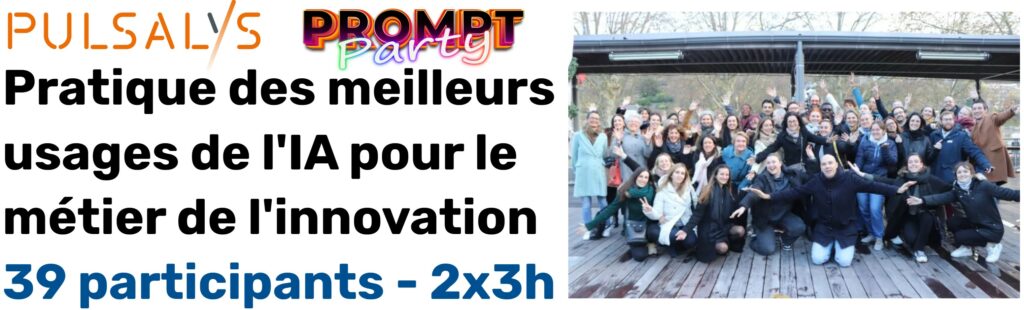
Prompt Party · SATT Pulsalys
Practical application of best practices in AI for the innovation profession
Participant satisfaction: Proximity, good pace, suitable for beginners, tailor-made / Very clear, concrete and relevant examples, pleasant trainer / Practice-based training, with examples adapted to Pulsalys' business, lively training / Dynamic, comprehensive, simplified explanations, numerous application cases / Clear and educational demonstrations, interactive exchanges and relevant answers to questions / Many examples with different uses / I started from scratch or almost, I learned a lot / Not too much theory and many interactive exercises / Clear and concise, many exercises / Available trainer, good simplification, pleasant support / Adapted to the SATT and its activities, dynamic and expert trainer / Clear and progressive presentation, technical on the agentic part / Numerous practical applications, very relevant for the future / Easy to use, can facilitate certain daily tasks / Exercises adapted to the structure, smooth and pleasant trainer / Very interesting case studies, concrete ideas to improve one's work method / Reminder of environmental impact, best practices / Clear explanations, easy to understand

Prompt Challenge · SATT Lutech
Generative AI at the service of innovation
Participant satisfaction: Practical cases adapted and related to our activity / Very interesting training, thank you / Good pace / Number of use cases (interaction modes, colors) / Responsiveness and exchanges / Examples from concrete cases / Interactivity / Popularization / Sympathy / Accessible discovery of the tone of AI / Lots of things learned / Allows you to unlock AI / New perspectives for daily work / Very nice coach / Good interactive training / Very good dynamics / Very fast working groups / Not too many lectures / Educational / Relevant in the face of the "hubbub" / Good strategy for formulating prompt AI requests / Participatory / Adapted example / Lots of tips / Interesting training / Pedagogy: balance between theory and practice / Allows you to link insights to how they work (empathy) / Concrete applications / Practical pedagogy and concept adapted to our professions / Allows you to imagine concrete uses that you hadn't thought of / Good prompt framework
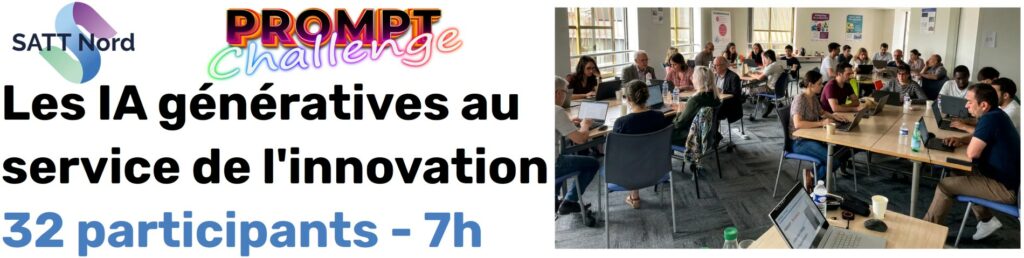
Prompt Challenge · SATT Nord
Generative AI at the service of innovation
Participant satisfaction: Competent and friendly trainer / Highly appreciated teaching methods / Reassuring dynamism that inspires / Concrete and diverse use cases / Practical application during sessions / Direct hands-on experience with our secure tool / Interactive training with discussions / Adapted to the company's context / Valued leveled groups / Accessible to beginners / Discovery of new AI capabilities / Support provided / Timetable respected / Highlighting of key points to consider / A lot learned / Very practical training / Clear explanations / Better understanding of AI possibilities / Diverse use cases / Agent creation covered / Concrete scenarios / Good adaptation to our business / Examples relevant to our activities

Prompt Challenge · SATT Conectus
Generative AI at the service of innovation
Sponsor satisfaction: I wanted to thank you very much for yesterday's training. The feedback has been very positive. Everyone has been raving about the quality of the content and the use cases presented.

Customer reference
Professional training in generative AI

Customer reference
Professional training in generative AI

Customer reference
Professional training in generative AI
Frequently asked questions about AI training for innovation teams
Answers to key questions about level, tools, personalization, and modalities.
Do you need to already know how to use ChatGPT or Copilot?
No. The content is adapted to the level of the participants, from discovery to more advanced methods.
Can the training use our internal tool?
Yes. The session can use the tool approved by your IT department, including Copilot, ChatGPT (Enterprise or Azure OpenAI), Gemini, Claude, Mistral or a local solution.
Can we work on our own use cases?
Yes. Priority situations are selected with your contact person, then transformed into suitable and safe exercises.
What is the difference between the 1 hour 30 minute format and the half-day format?
The shorter format focuses on familiarization and a few demonstrations. The half-day format allows for more hands-on practice with your specific use cases.
Can the training be funded?
Our training courses are eligible for OPCO and ESF+ funding.
Can AI help prioritize a portfolio of ideas?
Yes. It helps to clarify criteria, compare hypotheses and prepare a matrix, but the decision remains collective and human.
Is it possible to prototype during training?
Yes. Depending on the format, participants can transform an idea into a scenario, concept, or simple prototype to test.
How much does the training cost?
The price depends on the chosen format, the number of participants, and the number of sessions. We will send you a quote within 24 business hours of our initial discussion. Price ranges for standard formats can be found on the Corporate AI Training page.
How soon can a session be organized?
Allow one to two weeks between your agreement and the session, the time needed for framing with your innovation contact, personalization of exercises and validation of the schedule.
What deliverables do the participants receive?
A booklet of about fifty pages, the prompts and agents built during the workshop on your own cases, and the rules of use written collectively at the end of the session.
Let's build your customized innovation training program
Describe your situation in a few lines. We will get back to you within 24 business hours with a proposal tailored to your teams, tools, and schedule.
Do you prefer to call or write? +33 1 89 16 48 05 or hello@nextstart.aiYour contact details are only used to reply to you.
NextStart is a training organization registered under number 11756140675. This registration does not constitute state approval.