
Generative AI is locking in youth employment
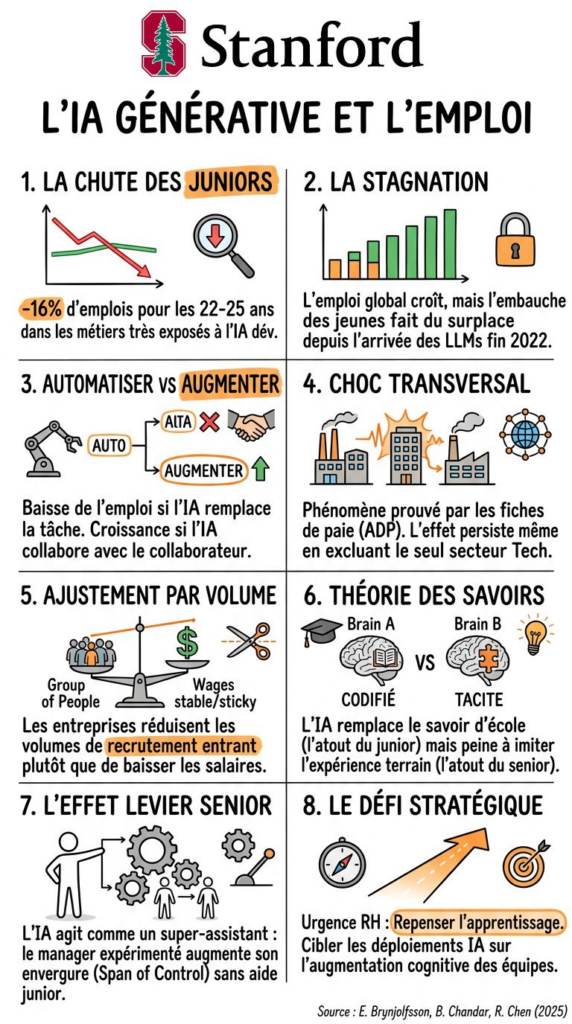
Generative AI is silently locking the front door of the job market.
By analyzing the pay stubs of millions of US workers, Stanford researchers spotted the infamous "canaries in the coal mine." And the warning is clear:
1️⃣ The fall of the juniors
Since the end of 2022, workers aged 22-25 have seen their employment fall by 16% in jobs highly exposed to AI, compared to jobs not exposed.
2️⃣ The Great Stagnation
It's a real paradox: the overall job market continues to grow… but the hiring of junior profiles is stagnating. Attrition in AI-related professions is pulling this average for recent graduates down.
3️⃣ The paradigm: automate vs. augment
Junior employment declines only where AI purely replaces a task (automation). Conversely, where AI is used collaboratively with humans (augmentation), employment remains stable or increases.
4️⃣ A transverse collision
Forget the excuse of an IT crisis or a boom in offshoring. The study shows that even in jobs that can't be done remotely or outside the tech sector, entry-level positions are disappearing. This cross-sector trend bears the hallmarks of AI.
5️⃣ An adjustment based on volumes (not prices)
So how do companies actually do it? They don't lower starting salaries (the famous "price"). They simply close the floodgates to new junior recruitment (the "volume").
6️⃣ The key explanation: School knowledge vs. tacit knowledge
Why do only young people stumble? Stanford's key hypothesis lies in the types of knowledge. AI excels at mimicking "school knowledge," theoretical and codified: the main asset that graduates sold. On the other hand, AI doesn't master field experience or customer relations: this "tacit knowledge" provides lasting protection for older generations.
7️⃣ The managerial “superpower”
As a corollary to the previous point: an experienced professional, enhanced by AI, significantly expands their scope of action. Their leverage increases, thereby reducing their need to rely on several junior assistants to produce results.
8️⃣ The major HR challenge
This is the classic apprentice problem. If AI performs the thankless tasks that all our senior employees started with… how will we train the next generation of managers and experts? The vital challenge for company leadership today is not to make short-term savings on entry-level positions, but to target the use of AI to enhance junior staff, otherwise the chain of skills transfer will be broken.
And in your organization, are you already feeling this freeze effect on the recruitment of young graduates?
Source: Stanford University paper: https://digitaleconomy.stanford.edu/app/uploads/2025/11/CanariesintheCoalMine_Nov25.pdf
On the same topic, see the King's College paper: https://papers.ssrn.com/sol3/papers.cfm?abstract_id=6134506
This article is based on one of my LinkedIn posts. See the original post and discussion on LinkedIn →
To learn more: discover why AI always says yesand AI will either destroy or transform our jobs and if AI threatens our critical thinking.