
Will AI destroy or transform our jobs?
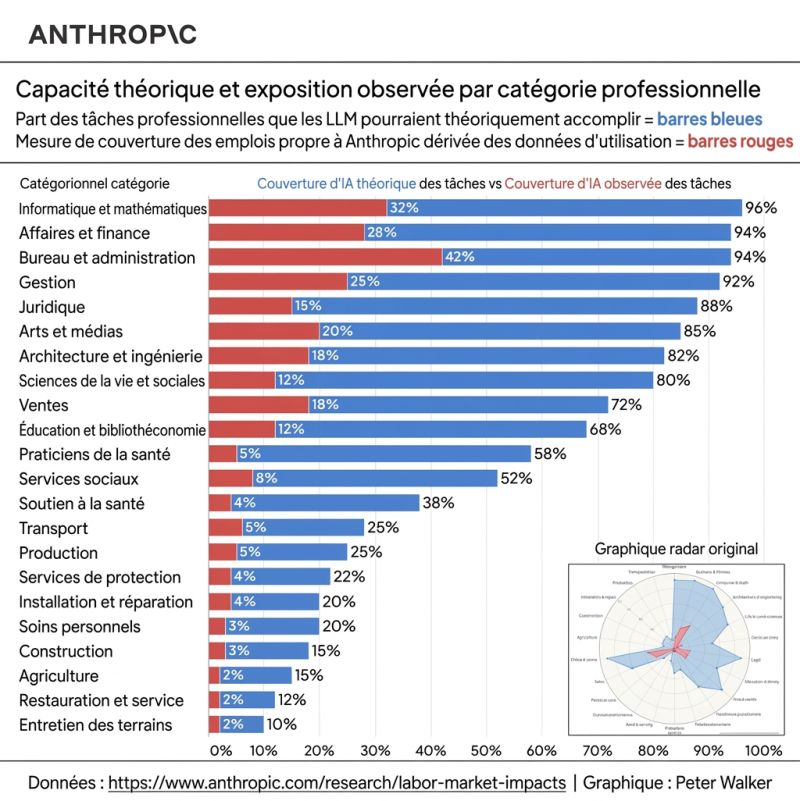
Will AI destroy or transform our jobs? To move beyond mere assumptions, Anthropic has just published a study that measures the actual adoption of AI by profession.
Instead of limiting themselves to what AI could theoretically accomplish, they cross-referenced it with the actual use of Claude by professionals.
Here are the 5 key takeaways:
1️⃣ Reality is still very far from theory
There is a significant gap between the capabilities of LLMs and their actual adoption. For example, while AI can theoretically impact 94% of tasks in IT professions, real-world usage is currently capped at only 33%. This gap is explained by human obstacles, legal constraints, requirements for human validation, technical integrations, and other factors.
2️⃣ The top 7 most exposed professions
Today, certain professions appear particularly exposed:
– Software developers (74,5%)
– Customer service agents (70,1%)
– Data entry operators (67,1%)
– Medical data managers (66,7%)
– Market research analysts (64,8%)
– Sales representatives (62,8%)
– Financial analysts (57,2%)
At the other end of the spectrum, 30% of workers have zero exposure: cooks, bartenders, mechanics, factory workers,…
3️⃣ The profile of the most “exposed” worker
Contrary to popular belief, the most exposed workers are slightly older (+2 years on average), predominantly women (+15.5 pts), significantly more educated (x4 for higher education degrees) and better paid (+47%).
4️⃣ No wave of unemployment detected
This is the reassuring finding of the report. Since the AI boom at the end of 2022, there has been no increase in unemployment among workers most exposed to AI.
5️⃣ A warning sign for young graduates (22-25 years old) ⚠️
While AI may not be causing layoffs, it appears to be hindering the hiring of junior staff. The study notes a decrease of approximately 14% in the employment rate for young people in highly exposed professions.
➡️ CONCLUSION
Paradoxically, AI doesn't destroy existing jobs; it locks the door to the job market. The real economic challenge of the decade will not be protecting current experts, but inventing new models to train and integrate the next generation.
👇 And you, are you observing a slowdown in the hiring of junior profiles in your sector?
🔵What LLMs could theoretically achieve (according to the model by Eloundou et al. DATING FROM 2023)
🔴Its actual adoption in companies (measured by Anthropic based on Claude's usage)
Source: Anthropic Publishing https://cdn.sanity.io/files/4zrzovbb/website/dc7bcd0224644fce97cecb7f9e68dcd8434b35f1.pdf
This article is based on one of my LinkedIn posts. See the original post and discussion on LinkedIn →
To learn more: find out if AI threatens our critical thinkinghow to find the balance between innovation and societal impact and why The effectiveness of LLM masks a risk of cognitive drift.