
AI does not eliminate the Dunning-Kruger effect, it shifts it
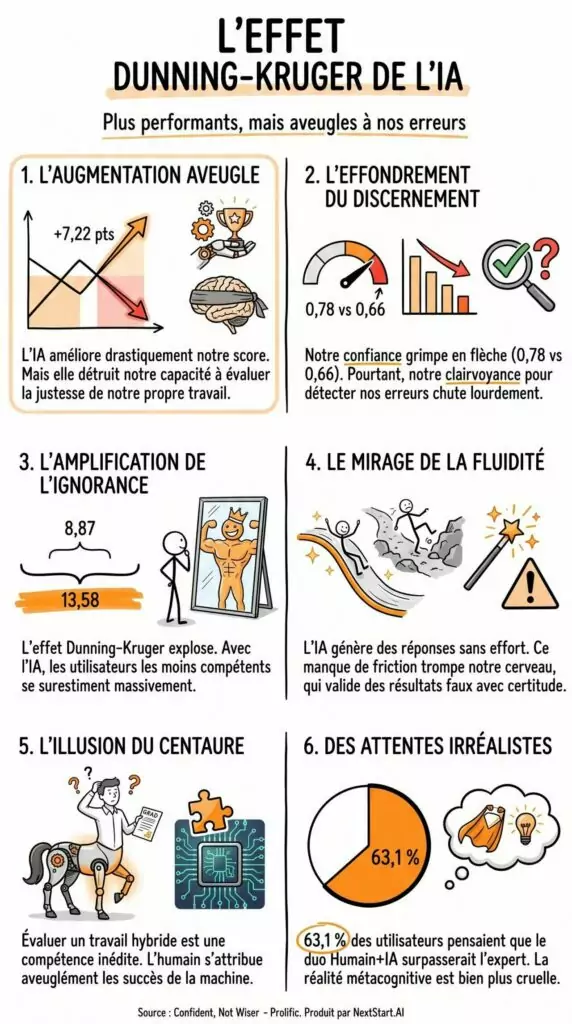
AI does not eliminate the Dunning-Kruger effect. It shifts it. LLM makes us more efficient, but less aware of our own mistakes: on average, we are less able to distinguish our correct answers from our incorrect ones.
This is the conclusion of a study from Aalto University (Finland). Researchers measured both the scores and the foresight of 366 British participants, divided into two groups, WITH or WITHOUT AI, across 40 reasoning tests. The issue goes beyond raw performance: it's about whether we remain capable of judging the quality of what we produce with AI.
Reminder: What is the Dunning-Kruger effect?
The Dunning-Kruger effect describes a self-assessment bias: people who perform the least well on a task tend to overestimate their ability the most. The question posed by the study is simple: does an AI assistant correct this bias, or does it reinforce it?
The 6 lessons from the study
1️⃣ Blind Augmentation
AI improves performance at the expense of metacognitive awareness, that is, the ability to evaluate one's own reasoning. The human-machine pair scores 7,22 points out of 40 compared to a human alone. However, its ability to judge its own responses does not keep pace. Competence increases, but lucidity does not.
2️⃣ The decline in judgment
Overall confidence levels rise, but this confidence is ultimately meaningless. AUROC, the indicator that measures the ability to distinguish correct answers from errors, drops across the entire battery of tests, even though the difference is no longer significant within a single task. In other words, the user makes fewer mistakes, but their confidence no longer differentiates between successes and errors.
3️⃣ The amplification of ignorance
The Dunning-Kruger effect does not disappear with AI; it even seems to intensify. The self-assessment gap between the lowest-performing and highest-performing quartiles becomes approximately one and a half times wider, increasing from 8,87 points without AI to 13,58 points with the machine's assistance.
4️⃣ The mirage of fluidity
Ordinarily, the ease with which an answer is found is a good indicator of success. With AI, this ease may simply reflect the fact that a suggestion was offered, rather than that a line of reasoning was successful. Our internal barometer then loses its reliability. This is a hypothesis of the authors, which was not measured in this study.
5️⃣ The Centaur Illusion
Evaluating hybrid work, combining human and machine input, is a unique exercise. Humans struggle to track AI performance from one task to the next. And according to the literature cited by the authors, they tend to take credit for successes achieved with AI. We simply don't yet know how to measure our own worth when we work in tandem with an algorithm.
6️⃣ No miracle expected
Participants without AI were also asked to estimate the performance of a human-AI duo. In 63,1% of their responses, this estimate simply equaled the best of their two estimates (human alone or AI alone), and only exceeded it in 24,6% of cases. This intuition proved quite accurate: in reality, the duo matched the AI alone without surpassing it. Only the quarter who expected true synergy were mistaken.
Key takeaways for using AI in everyday life
The study doesn't say we should do without AI: performance is indeed improving. However, it does suggest we stop taking our own sense of confidence as proof of quality. Several key points emerge from this:
- Separate trust from verification : a fluid and well-written answer is not necessarily a correct answer.
- First check what you know the least about. : this is precisely where the gap between perception and reality is greatest.
- To wonder who was really thinking straight : being able to explain why an answer is correct remains the best test.
How do you spot an error in an AI response that seems perfect? 👇
Source: Fernandes et al., Aalto University (Finland), Confidant, Not Wiser: The Dunning-Kruger Effect, September 25, 2026: https://arxiv.org/html/2609.31095v1
This article is based on one of my LinkedIn posts. See the original post and discussion on LinkedIn →
To learn more: this study expands on our article about the judgment that we unconsciously delegate to AI and our analysis Does AI threaten our critical thinking?