
AI does not reduce the workload, it increases it.
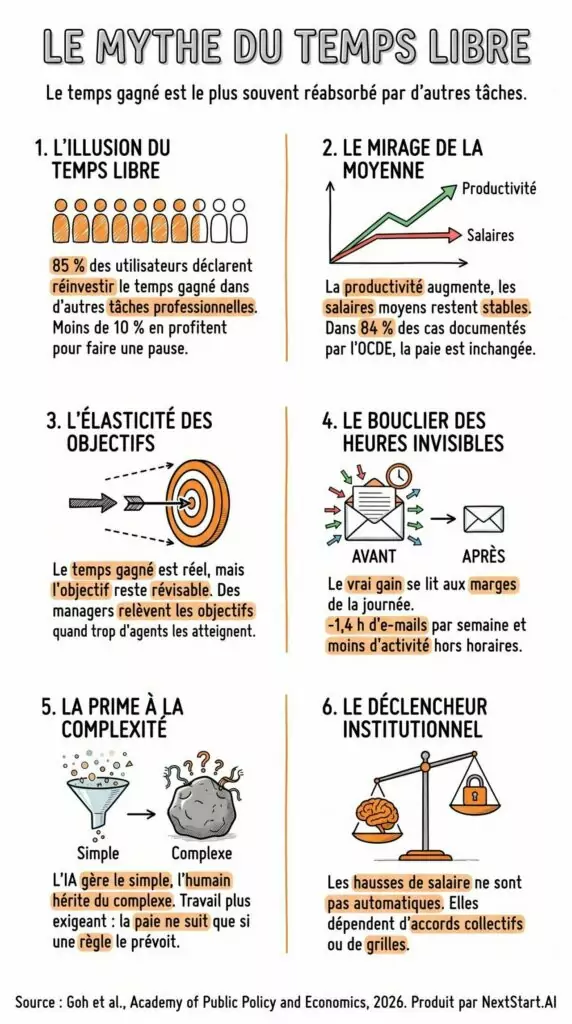
Until now, we thought AI would free up our time, but a Danish study shows that this time saved goes straight back into work. AI doesn't reduce the workload, it increases it.
1️⃣ The illusion of free time
The idea that AI will automatically free up leisure time is significantly challenged by the data. A Danish study reports that 85% of chatbot users say they reinvest the time saved in other tasks. Less than 10% use it to take a break. A large portion of the reported time is therefore reinvested in work.
2️⃣ The mirage of the average
Massive productivity gains can perfectly coexist with stagnant average wages. The OECD analyzed implementations in companies: in 84% of the cases studied, respondents reported unchanged salaries. The value created by the tool does not automatically pass on to employees.
3️⃣ The elasticity of objectives
Saving two hours a week thanks to AI is only a temporary advantage if the objectives are raised the following month. Brynjolfsson's study observes this in customer service AI allows for 15% more queries to be solved per hour, and the managers surveyed report raising targets when too many operators reach them.
4️⃣ The shield of invisible hours
The most immediate, measurable benefit of AI isn't reflected in salary, but rather in the margins of the workday. A randomized experiment involving 7,137 employees across 66 companies shows that access to a generative assistant reduces time spent on emails by approximately 1,4 hours per week and activity outside of regular working hours by 9%. AI is nibbling away at unseen work.
5️⃣ The premium on complexity
By automating simple everyday tasks, AI is changing the nature of jobs. In the case of the Austrian insurer, it leaves the representative with a greater share of complex cases. Without a clear reassessment of the role, the employee may end up exerting more cognitive effort for the same pay.
6️⃣ The institutional trigger
A salary increase following the adoption of AI is not automatically a direct result of performance. At an Austrian insurance company, respondents reported higher salaries, with the collective agreement granting them higher pay for more demanding work. Conversely, at a Japanese bank where job classifications remained unchanged, pay did not increase.
And you? What's your first reaction when AI frees up an hour: to tackle another task, or to perfect the one you're currently working on? 👇
Source: Academy of Public Policy and Economics, Who Controls the Gains from Workplace AI?, September 21, 2026: https://journal.pe.ac/Commentary-and-Critique/article/download/19/appe-proof-cc-p01-23ec41c5b1cc9d42
This article is based on one of my LinkedIn posts. See the original post and discussion on LinkedIn →
To learn more: this summary expands on our article about Cognitive load in the age of AI and our analysis of What AI could do to wages by 2030To decide as a team what to do with the freed-up time, see the AI-powered time-saving kit.