
How to adopt AI without sacrificing the well-being of your teams?
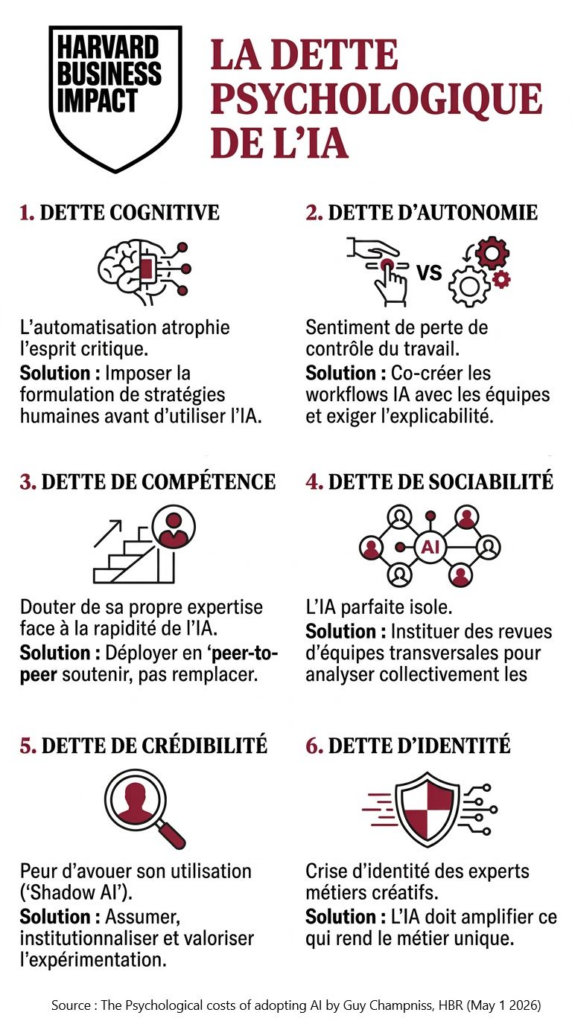
In the race for AI, most companies focus on the tools but forget the human element. Yet, an organization's psychological infrastructure is more fragile than its technological architecture. The result: demotivation negates the expected gains. This invisible cost is what a study published in HBR calls the "psychological debt" of AI.
1- Cognitive debt (When AI thinks for us)
By delegating too much, the risk is not of becoming "less intelligent", but of losing track of one's own thinking.
🎯The remedy: Introduce "cognitive friction." At JP Morgan, teams must formulate a clear hypothesis before engaging AI. It remains a guide for your thinking, never the decision-maker.
2- The debt of autonomy (The feeling of being a pawn)
When AI is imposed to boost production volume, the employee feels dispossessed of control over their job.
🎯The remedy: Co-produce algorithmic transparency. ING bank, for example, has created "nutritional labels" for each model so that humans can understand the data and regain control.
3- The debt of competence (The imposter syndrome)
An analysis that used to take three days is now generated in 4 seconds… The expert ends up doubting his own usefulness and value.
🎯The remedy: Train your teams in "peer-to-peer" mode, a Microsoft field initiative that allows teams to explore AI with their peers, while remaining grounded in their business skills.
4- The debt of sociability (Digital isolation)
AI is a good assistant, but it reduces social interaction, healthy disagreement, and team building.
🎯The remedy: Implement group rituals. Do like P&G, which organizes innovation project reviews where the AI outputs are discussed collectively between different departments.
5- The debt of credibility (The taboo of Shadow AI)
Many hide the fact that they use AI at work for fear of appearing incompetent: "I'll look like a fraudster or someone who's lazy."
🎯The remedy: Destigmatize the tool. Embrace it institutionally. Klarna has created such a strong testing culture that relying on its internal AI has become a source of pride.
6- The identity debt (The threat to one's know-how)
To automate the core of what defines a professional is to deny it.
🎯The solution: AI at the service of core business, not in its place. Philips helps doctors embrace AI because it streamlines their logistics and gives greater value to pure clinical practice and the time spent with patients.
Controlled adoption reduces suffering, not avoidance: a debt of 60/100 among non-users of AI, compared to 36/100 among intensive users.
Which of these 6 debts resonates with you the most? 🤔
Source: HBR article from May 1 Read the Harvard Business Review study
This article is based on one of my LinkedIn posts. See the original post and discussion on LinkedIn →
To learn more: see our analysis of productivity paradox and our article on how AI is being integrated into our work rituals.