
Yann LeCun and the World Models
LLMs have monopolized our attention in recent years. But according to Yann LeCunThe AI revolution is only just beginning…
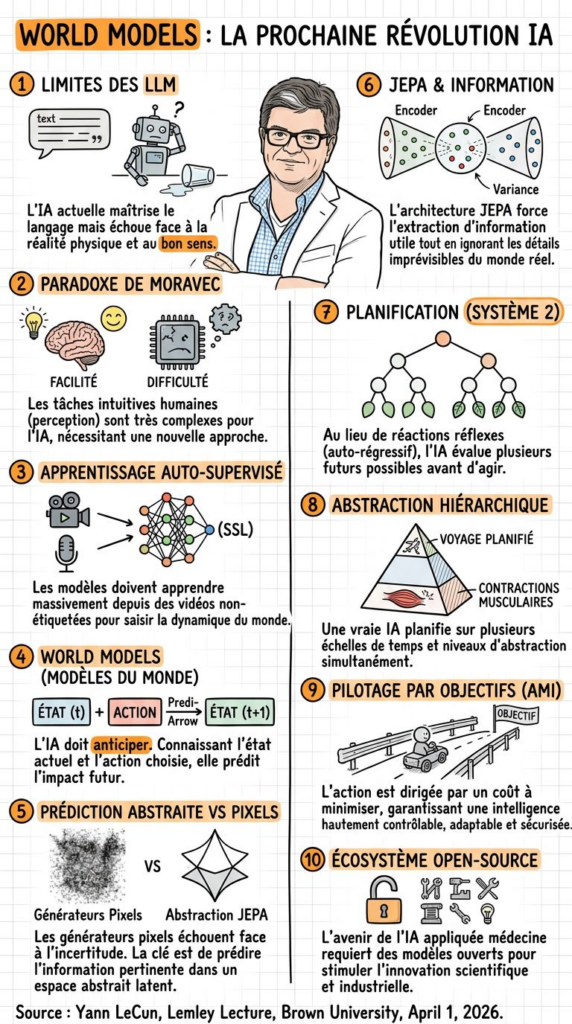
The goal? To move from a "generative" AI that recites to a "planning" AI that understands and acts in the real world:
1️⃣ The limitations of LLMs: They have a perfect grasp of syntax, but sorely lack common sense and physical logic. The real world cannot be reduced to a string of words.
2️⃣ Moravec's paradox: What is intuitive for a 4-year-old child, understanding gravity, manipulating an object, requires an unprecedented algorithmic complexity for a machine.
3️⃣ Self-Supervised Learning: To understand the world, AI must no longer be limited to text. It must "observe" hours of video and raw sensory data, just like a human.
4️⃣ World Models: This is the heart of the reactor. A model capable of anticipating the future by saying: "If I do action A in situation B, then I will obtain result C."
5️⃣ Abstract prediction: Trying to generate or predict the future pixel by pixel is doomed to failure; the world is too chaotic. AI must learn to make predictions about abstract concepts.
6️⃣ JEPA architecture: This is the technical solution proposed by LeCun. It forces AI to extract only the relevant information from a situation, ignoring unpredictable "noise".
7️⃣ Planning (the famous "System 2"): No more purely reactive responses. Tomorrow's AI will take the time to "imagine" and evaluate several possible futures before choosing the best course of action.
8️⃣ Hierarchical abstraction: Like us, the machine will have to plan on several scales: a long-term objective (going to the station) combined with immediate micro-decisions (taking a step, raising the arm).
9️⃣ Objective-driven management: AI guided by minimizing the cost of errors, framed by strict safety barriers. This is the key to a technology that is both adaptable and controllable.
🔟 An Open-Source Future: Innovation in critical areas will not happen in closed laboratories. The future of applied AI will be built in an open and collaborative way.
What do you think of this vision? Do you believe that "World Models" will replace our current approaches? 👇
Source: Yann LeCun's latest conference: https://www.youtube.com/live/ZbrfvMLZZK4?si=bQMRNlRV9tCND4zA&t=789
Supporting material for his presentation (47 slides): https://drive.google.com/file/d/1zTbQDIDOiRDiN790iPWzShMPux0z8o7z/edit
This article is based on one of my LinkedIn posts. See the original post and discussion on LinkedIn →
To learn more: discover the lecture by Arthur Mensch (Mistral) and our analysis of DeepSeek.