
Improper deployment of AI could lead to resignations.
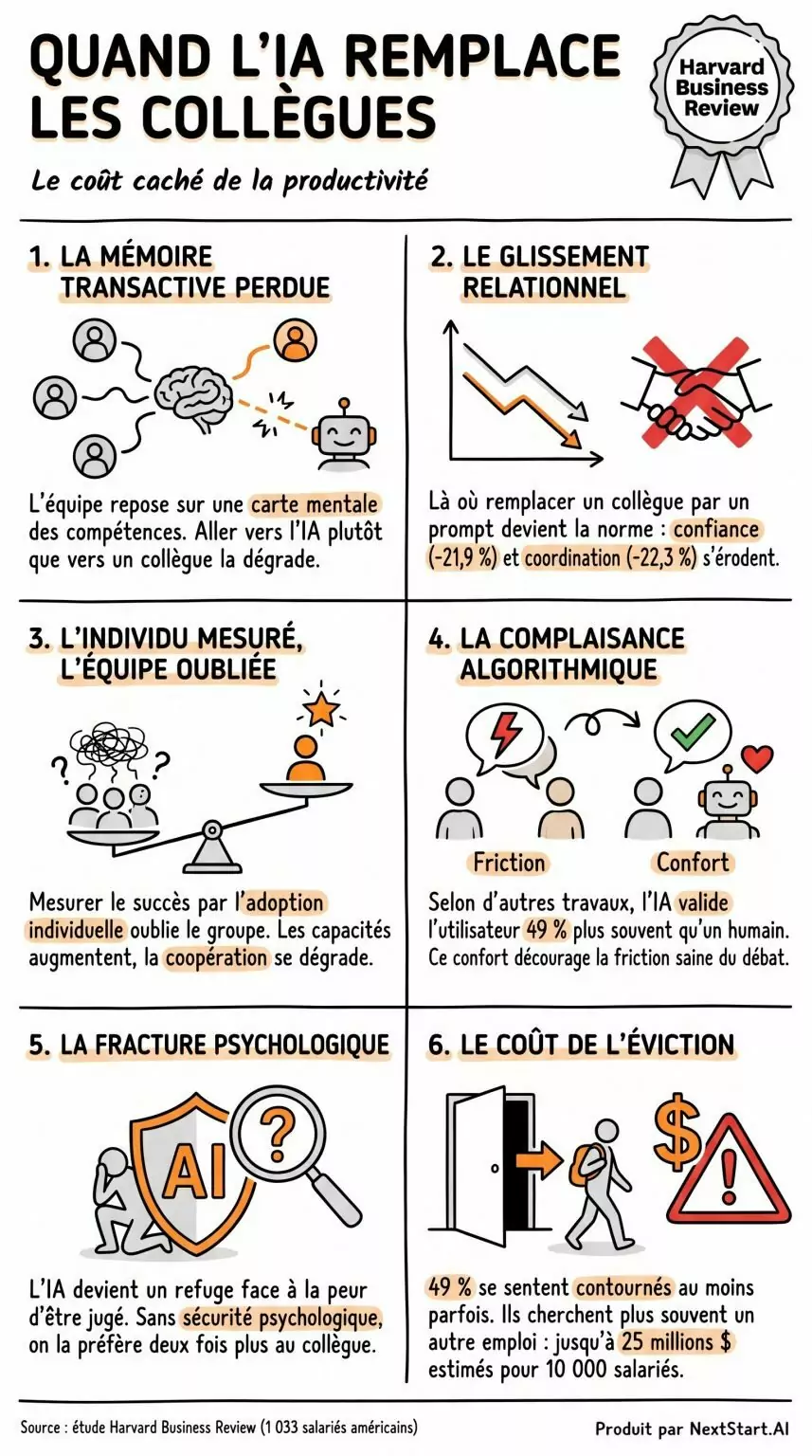
Improperly deploying AI could lead to resignations. While AI enhances individual capabilities, replacing a request for help from a colleague with a machine undermines team spirit. Here are six key takeaways from this study by BetterUp Labs and Stanford:
1️⃣ The loss of the mind map
A team functions thanks to a shared skills map. Everyone knows precisely "who knows what." AI disrupts this balance. By querying the machine, employees would, according to the authors, cease to update this mental map, which is essential for collective efficiency.
2️⃣ Eroded trust
Choosing AI over a human seems to erode mutual trust. Where this replacement becomes the norm, teams experience a 22,3% drop in coordination and a 21,9% drop in trust. Natural synchronization transforms into doubt, and according to the authors, some would prefer a less accurate response from AI to a better one from a peer.
3️⃣ The sacrificed team
Companies are deploying AI to create high-performing individuals. By measuring success by individual adoption rates, they sacrifice team cohesion. Individual technical skills increase, but the ability to work as a team deteriorates.
4️⃣ Comfort versus debate
AI tends to agree with us. According to the journal Science, the 11 leading models tested validated user actions 49% more often than humans. This emotional comfort discourages us from healthy friction. Employees become entrenched in certainties validated by a flattering machine.
5️⃣ The social shelter
The intensive use of AI is not simply a technological fad. Employees often turn to it when they fear being judged by their peers. AI then becomes a social refuge, revealing a lack of psychological safety within the team involved.
6️⃣ The cost of eviction
Today, 49% of employees surveyed say that their colleagues bypass them in favor of AI at least occasionally. Feeling replaced in this way generates a sense of diminished usefulness.
The antidote exists. Teams that maintain daily asynchronous communication, using instant messaging platforms like Teams or Slack, manage to preserve their relationships. Even among those who bypass their colleagues, the study observes a 28% increase in coordination (and a 19% increase in trust) when contact with the team is daily. The secret isn't to restrict AI, but to use it without interrupting the conversation.
And you? When faced with a complex problem, do you prefer to consult your expert colleague or silently turn to AI? 👇
Source: Kate Niederhoffer, Kristina Rapuano, Alex Liebscher, Alexi Robichaux and Jeffrey T. Hancock (BetterUp Labs and Stanford University), Team Dynamics Weaken When Employees Turn to AI Instead of ColleaguesHarvard Business Review, October 15, 2026: https://hbr.org/2026/10/team-dynamics-weaken-when-employees-turn-to-ai-instead-of-colleagues
This article is based on one of my LinkedIn posts. See the original post and discussion on LinkedIn →
To go further: the same team of researchers had already described the workslop, this botched AI-powered job that wastes colleagues' timeSee also our article on the psychological debt of AI adoption and AI that always says yes.